Green roof and stormwater questions
Green roofs to outfalls, answered plainly.
First the questions firms ask about the work on roofs and stormwater structures (upkeep, irrigation, inspection reports, maintenance agreements), then what Manteverde is built to record, what it never claims and what the free trial gives you. Wherever a page shows the answer, the answer links to it.
Coming soon
Claim early accessManteverde in a minute
What is Manteverde?
Software for the firms that inspect and maintain their clients’ green roofs and stormwater structures. It is built to keep each property on one record: roof zones and structures pinned on its site map, each inspected by the protocol for its type, findings followed to closure, and the Living Roof Report and annual Stormwater Inspection Report your client receives. The calendar, Maintenance Proposals, invoices and card payments sit on that same record.
Who is it built for?
Green and living roof maintenance specialists, stormwater inspection and maintenance companies, landscape firms that take on roofs and stormwater work, and installers that keep the maintenance after handover. Inside them: owners, account managers, crew leads and technicians, and the inspector who signs the report.
Which structures does it cover?
Green and living roofs first. Then the planted stormwater assets (bioswales, rain gardens, bioretention, vegetated swales, permeable paving), the grey structures the same inspections cover (catch basins and inlets, underground detention and retention vaults, oil-water separators, outfalls) and wet and dry stormwater ponds, inspected as structures.
Does it cover pond water quality?
No. Manteverde inspects a pond as a stormwater structure: its embankment, inlet and forebay, outlet riser and trash rack, emergency spillway, sediment and vegetation. Aeration, fountains, algae and weed treatment and water testing sit outside its protocols.
Is it for property owners, associations or cities looking for a maintenance firm?
No. It is built for the firm that does the work; owners, property managers, homeowners’ associations, campuses and cities appear as that firm’s clients. Manteverde doesn’t list, rate or recommend maintenance firms. Each of six kinds of client has a page written for the firm that looks after it.
Commercial propertiesHOA communitiesMunicipal and campusDevelopers
Green roofs: what the trade asks
Do green roofs need maintenance?
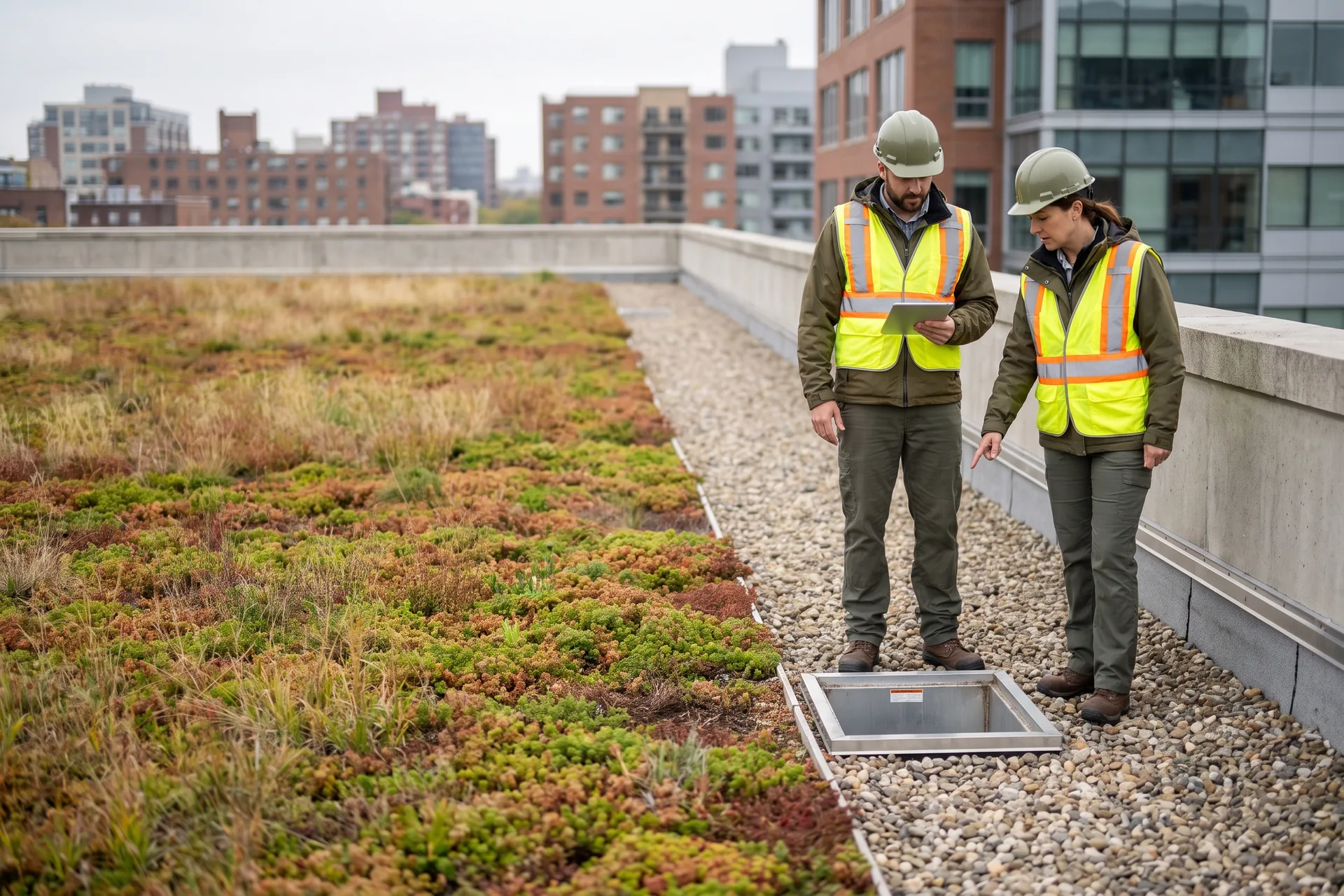
Yes. Even an extensive sedum roof built for low care needs regular visits: weeds and tree seedlings pulled, drain outlets and inspection chambers kept clear, bare patches filled and plants fed, usually more often while the planting establishes.
How often should a green roof be inspected?
As often as the roof’s maintenance plan and your client’s agreement say. Many established roofs are visited in spring and autumn, with more visits during establishment and a check after severe weather; the plan for each roof decides.
Do green roofs need irrigation?
Most need watering while the planting establishes. An established extensive roof often needs water only in long dry spells, while intensive roofs and roofs in hot, dry climates usually carry an irrigation system that is checked on each visit.
Can you walk on a green roof?
Maintenance walking on an established extensive roof is normal, but it isn’t a terrace unless it was designed as one. Safe access, edge protection and the roof’s design come first, under your firm’s own procedure.
What does a green roof inspection cover?
Vegetation cover and health against the specification, weeds and unwanted growth, drain outlets and inspection chambers, the vegetation-free strips along edges, substrate erosion, irrigation, and the membrane edges and flashings, which are looked at, never tested.
Is a green roof inspection a membrane or leak test?
No. A maintenance visit can see exposed edges, upstands and flashings, not the waterproofing beneath the layers. Inspections document observable surface conditions; Manteverde does not warranty or certify membrane integrity.
Stormwater structures: what the trade asks
What is a stormwater BMP?
A “best management practice”: a structure or feature that controls how much runoff leaves a developed site, or how clean it is. Rain gardens, bioswales, permeable paving, ponds, underground vaults and separators are all BMPs.
How often does a stormwater BMP need inspecting?
As often as the local rules and the site’s recorded agreement require, which varies from place to place. A yearly inspection is common, and many sites add checks after heavy storms.
Who is responsible for maintaining a stormwater pond or structure?
Usually the property owner (a business, a landlord, a homeowners’ association), under a maintenance agreement or covenant recorded against the property. Many owners hire a maintenance firm to do the work and keep the records.
What goes in a stormwater inspection report?
The structure and where it is, the date and the inspector, why it was inspected, its condition item by item with readings and photos, the problems found and what was done or recommended, often closed by a statement the inspector signs.
When does a catch basin need cleaning?
When the sediment and debris in its sump reach the level set for that basin by its design, your client’s agreement or local guidance. Many sites clean basins at least once a year; a reading tells you when one can’t wait.
Does inspecting an underground vault mean going inside?
Often not: much of a routine inspection can be done from the access opening. Entering a vault is confined-space work, done only by trained, equipped people under your firm’s own procedure.
What does a stormwater maintenance agreement ask for?
Typically that the owner inspects and maintains each structure to its approved plan, keeps records, produces a yearly inspection report and allows the authority to check. The exact terms are in the recorded document for that site.
What is the difference between a retention pond and a detention pond?
A retention (wet) pond keeps a permanent pool of water; a detention (dry) pond holds runoff for a while after rain, then drains empty. The two words are often mixed up, so the site’s design is the one to go by.
How often is a stormwater pond inspected or dredged?
Inspected as the site’s agreement says, often yearly and after big storms. Sediment comes out only when the forebay or pool has filled to the level the design, or the inspector’s findings, call for.
What Manteverde records
How is a client’s property set up?
Each property has its own site map. Roof zones and stormwater structures are pinned where they sit, each with its type, its ID and the notes your crew needs to reach it, and opening a pin opens that structure’s whole history.
Can I set my own inspection checklists?
Yes. You set the protocol for each structure type once (the items, the readings, the photos you expect) and every inspection of that type follows it, so one year’s record lines up with the next.
Does Manteverde set cleanout triggers or coverage targets?
No. Readings such as sediment depth, standing water or vegetation coverage are drawn against the targets your firm sets for each client, from the design, the agreement or local guidance. There are no built-in pass marks.
How are findings followed up?
Each finding carries its structure, its photo and one of three severities (routine, attention needed, deficiency). It stays open until a later visit closes it, with the work done and a photo after.
Does it use sensors, drones or weather feeds?
Not at launch. Readings are taken by your people on site. Live sensors, irrigation controllers, weather feeds, and drone, CCTV or satellite imagery are not part of the launch; you add a post-storm inspection to the calendar when you decide one is needed.
Where does AI come in, and does it work without a signal?
AI only drafts a summary that you edit before anything is sent; findings, readings and severities are what your people record. Manteverde runs online on a phone, tablet or computer, and working without a signal is not promised at launch.
Reports, and what they never claim
What is the Living Roof Report?
The report on a client’s green roof, zone by zone: its condition, vegetation coverage against the specification, drainage checks, findings and what was done about them, with photos.
What is the Stormwater Inspection Report?
The yearly report on each stormwater structure: what was inspected and by which protocol, the readings, findings and actions, the photos, and a statement signed by your inspector with their credential.
Does a report go to my client automatically?
No. A report leaves when you decide: because your client asked, because you want them to see it, or on a timetable you set. It carries your company’s name, arrives as an emailed PDF or a link, and never sends itself.
Does Manteverde file reports with the city, or make my client compliant?
No. It never files anything with a city or agency, and no report says a structure is compliant or certified. Reports are formatted for submission; operators remain responsible for jurisdictional compliance, and any submission is your client’s to make.
Does it certify that a vault, pond edge or roof is safe to work on?
No. It keeps the access and safety notes your procedure asks for (confined space, traffic, keys, fall protection, open water) and shows them on the visit. It never certifies an entry, a structure or a site as safe.
What is the Work Record?
The record of one finished job: what the crew did and when, a photo before and one after, materials, time on site and the crew lead’s note. It stays on file and reaches your client only when they ask or you decide to send it.
The rest of the working week
How are the season’s visits scheduled?
On the Season Calendar: spring, summer and autumn roof visits, the annual stormwater inspection per structure, cleanouts and the post-storm checks you add, property by property.
Can a maintenance agreement repeat on its own?
Yes. An agreement’s visits are set up once as a recurring series, so each season’s work appears on the calendar without being entered again.
Can I send proposals and invoices, and take payment?
Yes. A proposal for a cleanout, a repair or a season’s agreement goes to your client; asking for approval and taking a deposit are optional, set per job. Work is invoiced on completion, payable by card online or by the payment methods of your country that you switch on in payment settings.
How does the inspector’s credential appear on a report?
The inspector who signs adds their credential to their profile, and it prints beside their signature on each Stormwater Inspection Report. Manteverde shows what your inspector enters; it doesn’t verify it.
Launch, pricing and the trial
Is Manteverde live today?
Not yet; Manteverde opens soon. Everything here is what it will do from day one, and the clients in the scenes are invented, their figures samples.
Will there be a free trial?
Yes. At launch you can try The Operation free for 14 days: up to five users, 750 AI interactions and no credit card. Live payments switch on when you upgrade. If the AI interactions run out, everything else keeps working, and voice and commands return once you choose a plan. After 14 days the workspace becomes read-only until you pick a monthly or yearly plan.
What will it cost?
Three plans (The Specialist, The Operation, The Portfolio), billed monthly or yearly in the currency of your country. See them on the pricing page, priced for the market picked in the header.
If I claim early access, am I signing up for anything?
No. Once you confirm your email address, launch news arrives by email, and one click stops it whenever you like. No account is created.
Which languages will it speak?
Four: English, Spanish, Brazilian Portuguese and French, the same as these pages.
Your details and your data
Which of my details does Manteverde keep when I claim early access?
Your full name and work email, which you give with your consent and which are handled as the privacy notice describes. A confirmation email checks the address first, before anything else is sent.
Who can see my firm’s records?
Your firm, and the people on your team you add. Clients only see what you send them.
Inspections record what is observed on the day. Manteverde does not warranty or certify membrane integrity, structural condition or safe entry, and never files anything with a city or agency: reports are formatted for your client’s own submission.
Founding access
Still wondering? Founding access is the next step.
Founding access is open to the firms that look after their clients’ green roofs and stormwater structures. The launch news reaches you first.
Launching with a 14-day free trial. No card needed.
Coming soon
Claim early access