
Glossary · green roofs and stormwater structures
The words on an inspection record, defined.
Roof zones and substrate, bioswales and catch basins, vaults, forebays, risers and outfalls: the terms green roof and stormwater maintenance firms write on every visit, explained plainly, and where Manteverde keeps each one.
Coming soon
Claim early accessThe detail sheet
Three details from an inspection file, every number a term.
A green roof’s build-up at the parapet, a catch basin and its sump, a pond’s outlet structure: the parts an inspection looks at, drawn the way a detail sheet draws them. As you scroll, the detail marker steps from part to part and each number lights its term below.
AGreen roof build-up, at the parapet
BCatch basin and sump
CPond outlet structure
60 terms
Nothing in the glossary matches. A shorter word may find it.
Green and living roofs
The roofs themselves, their layers and the places an inspection looks.
13 terms- Green roof
A roof covered with planting that grows in an engineered substrate over a drainage layer and a waterproofing membrane. It slows and holds rainwater, so its drains and its planting need regular inspection.
Also called Living roof, vegetated roof
- Extensive green roof
A shallow, lightweight green roof, usually sedum or other hardy low plants, built to need little care but not none. Visits clear drains, weeds and bare patches.
- Intensive green roof
A deeper roof garden with lawns, shrubs or trees, irrigation and paths. It is looked after much like a garden, with more frequent visits than an extensive roof.
Also called Roof garden
- Semi-intensive green roof
The middle ground between extensive and intensive: a moderate substrate depth planted with perennials and grasses, usually with some irrigation.
- Blue-green roof
A green roof with a water-storage layer under the planting that releases stored rain slowly through a flow-control outlet. That outlet is inspected like any other stormwater control.
- Roof zone
A part of a green roof inspected as one unit, usually divided by drainage area, exposure or planting type. Zoning keeps every finding tied to the place it was seen.
In Manteverde, each roof is split into roof zones on the property’s record, and every inspection is made zone by zone.
- Substrate
The engineered growing medium on a green roof: lighter and freer-draining than garden soil. Its depth and any erosion are checked on each visit.
In Manteverde, substrate depth is recorded per zone against the specification you set.
Also called Growing medium
- Drainage layer
The board or mat beneath the substrate that carries water to the roof drains and keeps roots out of standing water.
- Filter fabric
A geotextile between the substrate and the drainage layer that stops fine particles washing into the drainage layer and the drains.
Also called Filter sheet
- Waterproofing membrane
The layer under all of a green roof’s layers that keeps water out of the building. A maintenance visit can only look at its exposed edges; it does not test or warrant it.
In Manteverde, membrane edges and flashings are visual check items with a photo; Manteverde does not warranty or certify membrane integrity.
- Membrane edge
Where the waterproofing turns up at parapets, walls and roof penetrations. Plants growing into it, or debris piled against it, are common findings.
Also called Upstand, flashing
- Vegetation-free zone
A strip of gravel or paving slabs kept clear of planting along roof edges, drains and penetrations, so outlets stay reachable and the membrane edge stays visible. Weeds in it are a routine finding.
Also called Gravel margin
- Roof drain outlet
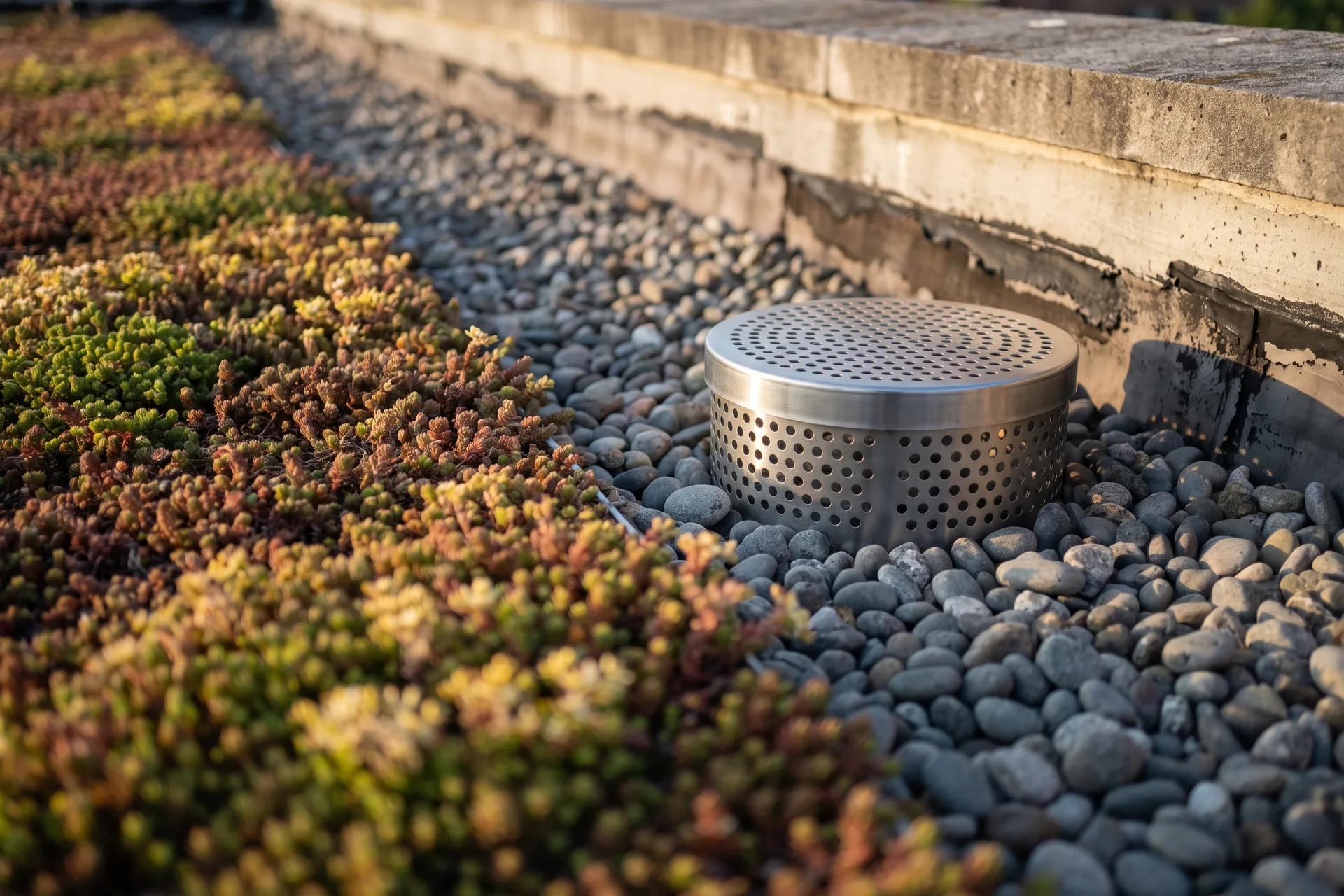
The point where water leaves the roof, usually under a removable inspection chamber that keeps roots and gravel out. A blocked outlet can flood the roof.
In Manteverde, each drain outlet is part of its zone and is checked on every visit.
Also called Inspection chamber, roof drain
Planted stormwater assets
Planted features that slow, filter and soak up runoff where it lands.
9 terms- Green stormwater infrastructure
Planted features that manage rain where it falls (green roofs, bioswales, rain gardens, bioretention and permeable paving) instead of piping it straight away.
Also called GSI; SuDS (UK); WSUD (Australia)
- Bioswale
A planted, gently sloping channel that carries runoff while plants and soil slow and filter it. Inlets, check dams, sediment and plant cover are the usual checks.
In Manteverde, this is a structure type with its own inspection protocol, pinned on the property’s site map.
- Vegetated swale
A shallow grassed channel that carries runoff and traps some of its sediment. Grass height, erosion and blockages are what an inspection looks for.
Also called Grass swale
- Rain garden
A shallow planted hollow that collects runoff from roofs or paving and lets it soak away. It should be dry again within the time its design allows after rain.
In Manteverde, this is a structure type with its own inspection protocol, pinned on the property’s site map.
- Bioretention cell
An engineered rain garden with a designed soil mix, often an underdrain and an overflow, built to filter runoff before it leaves the site.
In Manteverde, this is a structure type with its own inspection protocol, pinned on the property’s site map.
Also called Bioretention basin
- Permeable paving
Paving that lets rain pass through its surface into a stone layer below: porous asphalt, pervious concrete or open-jointed pavers. Clogging is its main maintenance issue.
In Manteverde, this is a structure type with its own inspection protocol, pinned on the property’s site map.
Also called Porous or pervious paving
- Infiltration trench
A stone-filled trench that stores runoff and lets it soak into the ground. Sediment reaching the stone is what shortens its life.
- Filter strip
A gently sloping band of grass or planting that runoff crosses before it reaches a swale, a pond or a drain, dropping sediment on the way.
- Drawdown time
How long a planted stormwater feature takes to empty after rain. Water standing longer than the design intends usually points to clogging.
In Manteverde, this is a reading drawn against the limit your firm sets for that client; there are no built-in pass marks.
Grey structures
The basins, pipes, vaults and outlets the same inspections cover.
12 terms- Catch basin
A street or car park drain with a grate on top and, usually, a sump below that traps sediment before water enters the pipes. Its sump is measured and cleaned out when it fills.
In Manteverde, this is a structure type with its own inspection protocol, pinned on the property’s site map.
Also called Storm drain, gully (UK)
- Inlet
Any opening where runoff enters the drainage system: a curb opening, a grate or a pipe end. Debris across it is the most common finding.
Also called Curb inlet, curb cut
- Sump
The space below the outlet pipe in a catch basin, manhole or separator where sediment settles. How full it is decides when it is cleaned.
In Manteverde, this is a reading drawn against the limit your firm sets for that client; there are no built-in pass marks.
- Manhole
A covered shaft that gives access to pipes and chambers for inspection and cleaning.
Also called Access structure, maintenance hole
- Underground detention vault
A buried tank, pipe system or set of chambers that stores runoff during a storm and lets it out slowly through a control outlet. Sediment, the outlet and the structure are inspected from the access openings.
In Manteverde, a vault carries its access and safety notes, and the inspection records what was seen from the opening.
Also called Detention tank, attenuation tank (UK)
- Underground infiltration chamber
A buried storage system that lets stored runoff soak into the ground instead of releasing it through a pipe.
- Flow restrictor
A plate or fitting with a sized opening that limits how fast stored water leaves a pond, vault or roof. If it blocks, water backs up behind it.
Also called Orifice plate, flow control
- Outfall
The point where a drainage pipe discharges into a ditch, stream or other water. Inspections look at the structure, erosion, blockages and anything flowing in dry weather.
In Manteverde, this is a structure type with its own inspection protocol, pinned on the property’s site map.
- Energy dissipater
Rock, a riprap apron or a structure at an outlet that slows the water so it doesn’t scour the ground. Displaced rock is a common repair.
Also called Riprap apron
- Oil-water separator
A chambered tank that holds back oil and grit from car parks, depots and fuel areas before the water moves on. Its oil layer and sludge depth are measured.
In Manteverde, this is a structure type with its own inspection protocol, pinned on the property’s site map.
Also called Interceptor (UK), oil-grit separator (Canada)
- Hydrodynamic separator
A manufactured unit that swirls incoming runoff so sediment and floating debris separate out. It is maintained to its manufacturer’s manual.
- Trash rack
A bar screen over an outlet or riser that stops debris blocking it. Clearing it is often the most frequent task at a pond.
Ponds as structures
Stormwater ponds as Manteverde inspects them: banks, inlets, outlets and sediment, never the water’s chemistry.
9 terms- Wet pond
A stormwater pond that keeps a permanent pool of water and holds extra runoff above it during storms. Its structure (embankment, inlets, outlet, sediment) is what a maintenance inspection covers.
In Manteverde, a pond is inspected as a structure: water quality work stays outside its protocols.
Also called Retention pond
- Dry pond
A basin that is dry between storms and fills for a while after rain, draining through a controlled outlet. Water standing long after rain is a finding.
In Manteverde, a pond is inspected as a structure: water quality work stays outside its protocols.
Also called Detention basin
- Extended detention basin
A dry pond designed to drain slowly over a longer period, so more sediment settles out before the water leaves.
- Forebay
A small, separate pool at a pond’s inlet where most of the sediment settles, so it can be cleaned out without disturbing the main pond.
In Manteverde, this is a reading drawn against the limit your firm sets for that client; there are no built-in pass marks.
- Embankment
The earth bank that forms a pond’s side or dam. Slumping, seepage, animal burrows and trees growing on it are findings to watch closely.
Also called Berm
- Riser
The upright outlet structure that sets a pond’s water level and controls its release. Its openings and its trash rack are checked for blockage.
Also called Outlet structure, principal spillway
- Emergency spillway
The overflow path that lets a pond pass a storm bigger than its outlet can handle. It has to stay clear of trees and debris.
- Stormwater wetland
A shallow pond planted with wetland vegetation that treats runoff as it flows slowly through.
- Sediment removal
Taking built-up sediment out of a pond, forebay, vault or sump once it reaches the level the plan sets. It gives the structure back its storage.
Also called Dredging, cleanout
Inspection and records
How a visit is organized, measured and written down.
11 terms- Stormwater BMP
A “best management practice”: in the US, any structure or practice that controls the amount or quality of runoff, from a rain garden to an underground vault.
Also called Best management practice, stormwater control measure
- Inspection protocol
The checklist used for one type of roof zone or structure, so every visit checks the same things in the same order and results compare from year to year.
- Finding
Something an inspection records that needs noting or action: a blocked outlet, bare patches, sediment building up. Each finding has a place, a photo and a severity.
In Manteverde, every finding carries one of three severities: routine, attention needed or deficiency.
- Deficiency
A finding that needs repair or maintenance before the structure works as intended. It stays open until a later visit closes it, with a photo of the work.
In Manteverde, a deficiency is followed from the photo that found it to the photo that closed it.
- Vegetation coverage
The share of a planted area covered by living plants, judged against the target in the specification.
In Manteverde, coverage is recorded zone by zone and drawn against the target you set from the specification.
Also called Plant cover
- Specification
The design document that says what should be planted where and how much cover is expected. It is the baseline vegetation coverage is judged against.
Also called Vegetation plan, planting plan
- Sediment depth
How much material has built up in a sump, forebay, vault or pond, measured from a fixed reference point. It tells you when a cleanout is due.
In Manteverde, this is a reading drawn against the limit your firm sets for that client; there are no built-in pass marks.
- Photo timeline
The same view of a zone or structure photographed visit after visit, so change over months and years can be seen.
- Site map
A plan of a property with every roof zone and structure pinned on it, so a crew can find each one along with the notes for reaching it.
- Access and safety notes
What a crew needs to reach a structure under the firm’s own procedure: keys and gate codes, confined-space rules, traffic control, fall protection.
In Manteverde, the notes come up on the visit; Manteverde never certifies an entry, a structure or a site as safe.
- Confined space
An enclosed space such as a vault or deep manhole, with limited ways in and out and air that may be hazardous. Entry follows the firm’s procedure with trained people; many inspections are made from the opening.
Agreements and reports
What the client has agreed to, and what your firm hands back.
6 terms- Stormwater maintenance agreement
A recorded agreement in which a property owner commits to inspect and maintain the site’s stormwater structures, often with a yearly inspection report. The owner is your client; your firm does the work and supplies the records.
Also called Maintenance covenant, O&M agreement
- Inspection frequency
How often each roof zone or structure is inspected, set by the client’s plan or agreement, the design and the season.
In Manteverde, each agreement’s visits sit on the Season Calendar, and you add a post-storm check when you decide one is needed.
- Post-storm inspection
An extra visit after heavy rain to check outlets, overflows and erosion while any problem is still easy to see.
In Manteverde, each agreement’s visits sit on the Season Calendar, and you add a post-storm check when you decide one is needed.
- Living Roof Report
Manteverde’s report on a client’s green roof: each zone’s condition, coverage against the specification, the findings and what was done, with photos.
In Manteverde, it reaches your client when you decide: because they asked, because you choose to, or on a timetable you set.
- Stormwater Inspection Report
The yearly report on each stormwater structure: what was inspected, the readings, findings and maintenance, signed by the inspector and formatted for the client’s own submission.
In Manteverde, the report is never filed with a city or agency; your client makes any submission.
Also called BMP inspection report
- Work Record
The record of one finished job: what was done and when, a photo before and one after, materials and the technician’s note. It stays with the structure, and the client gets it only on request or when you choose to share it.
Inspections record what is observed on the day. Manteverde does not warranty or certify membrane integrity, structural condition or safe entry, and never files anything with a city or agency: reports are formatted for your client’s own submission.
Keep exploring
Where the terms are put to work.
- Stormwater inspectionsEvery structure on the site map, inspected by its protocol and reported once a year.See the site map
- Living roof recordsRoof zones, vegetation coverage against the specification, drainage and substrate.See the roof zones
- FAQStraight answers about green roof upkeep, stormwater inspections and the launch.Read the answers
Founding access
Put every term on one record.
Every term on this page is something Manteverde is built to keep on record, zone by zone and structure by structure.
Launching with a 14-day free trial. No card needed.
Coming soon
Claim early access